
Feature
Give every inspection a clear next step
Bring findings, evidence and suggestions together with eight groups of 31 read-only checks. Compare changes and export a report ready to share.
Every finding carries its evidence
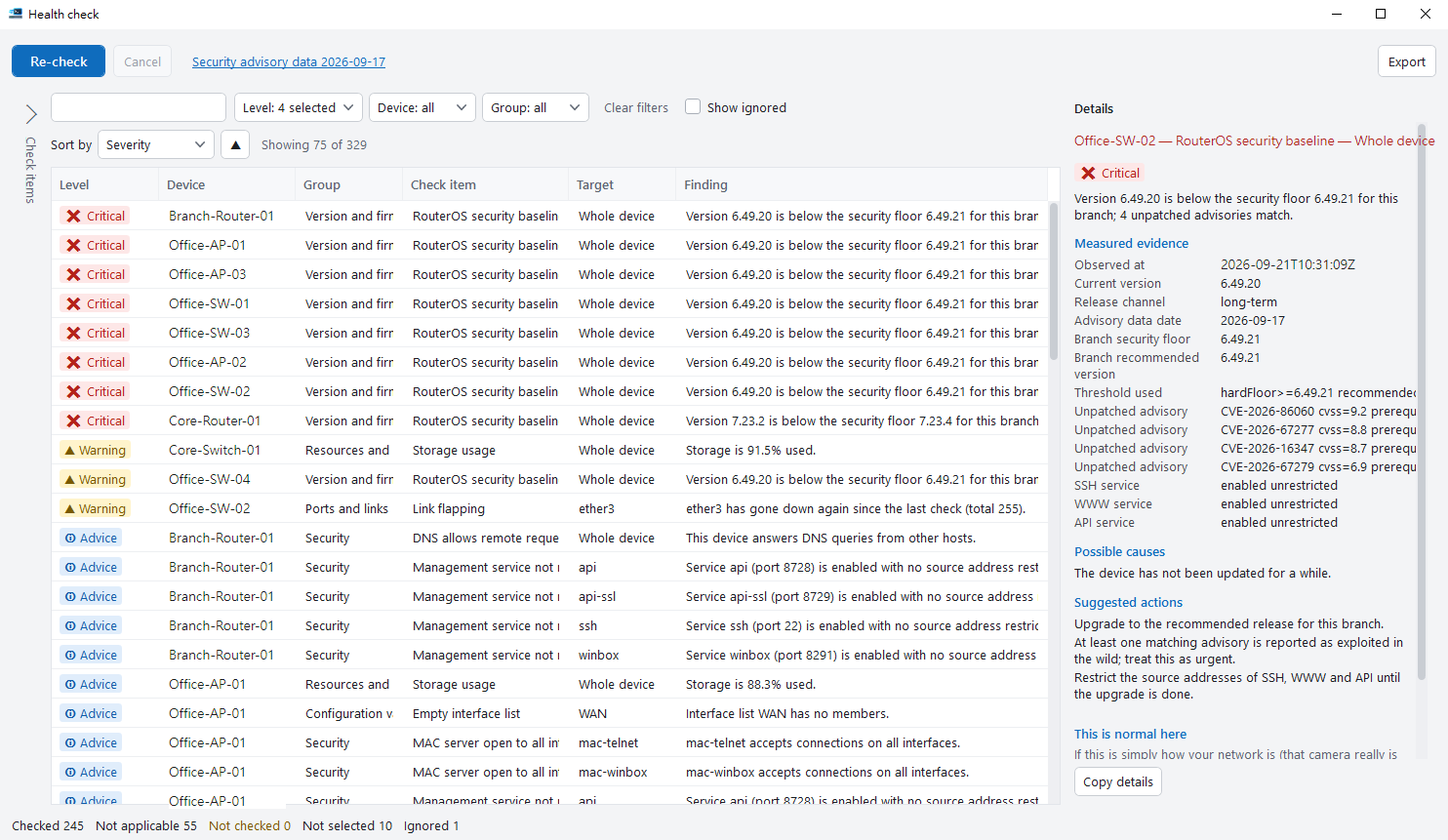
Each row states three things: the severity, the value actually measured, and the recommended action. A verdict you cannot verify independently is a verdict you cannot act on with confidence.
- Four severity levels — normal, advisory, warning and problem. "Not applicable" and "could not be read" are reported separately, so an unread check is never presented as a pass.
- Results compare against the previous run, showing what has changed rather than requiring the full list to be re-read.
- A finding reviewed and accepted as intended can be marked as expected. The mark applies to that check on that device and persists between runs; the same check still reports on other devices.
- Reports export to HTML or CSV, optionally replacing device identifiers. The export states what the file will contain before it is written.
Eight groups, 31 checks
The groups to include are selected before each run. The confirmation screen reports how many checks are selected out of the total.
| Group | Scope |
|---|---|
| Version and firmware | The running release compared against the version that corrected known issues, and whether the hardware firmware has kept pace. An online version lookup is available as an option |
| Ports and links | Ports negotiated below their capability, half-duplex links, error and discard counters, links that repeatedly drop and re-establish, and alarms reported by optical modules |
| PoE | On hardware capable of supplying power over the network cable, the power state of each port and any conditions requiring attention |
| Time | Clock accuracy and time synchronisation — an incorrect clock complicates every subsequent log |
| Resources and hardware | CPU, memory, storage, and the values the hardware reports about itself |
| DHCP and WAN | The address allocation service and the state of the upstream connection |
| Configuration validity | Settings that contradict one another, or that appear configured but will not take effect |
| Security | External exposure, and configuration weaknesses identifiable from a read-only session |
Group names match those used in the application. Two checks require the device to originate traffic — attempting an outbound connection to verify reachability — and are therefore disabled by default. Where a device has no outbound path, those checks return "could not be read", which is not a failure.
Next: running an audit in practice
The documentation covers selecting the scope, interpreting each severity level, the behaviour of marked findings, and the contents of an exported report.